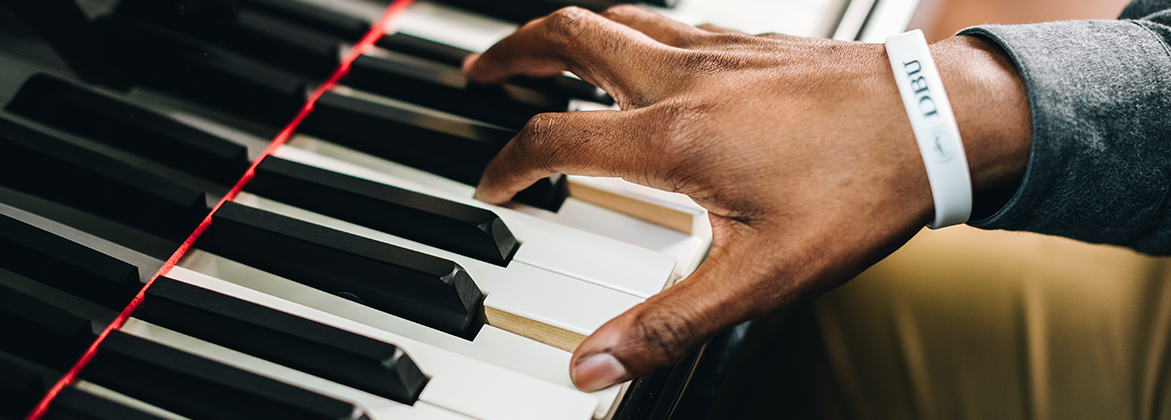
Audition Dates for Music Majors
All students who intend to study music MUST complete the audition process prior to entering DBU as a music major. For more information, please visit Frequently Asked Questions About Music Auditions.
The DBU Department of Music is thrilled to know of your interest in undergraduate music study. We want to encourage you to complete these important steps in the admissions/audition process as soon as possible:
- Apply for Admission to the University
- Review the Music Audition & Application Information
- Complete the Online Audition Signup Form*
*Note: You will need to have a PDF of your optional recommendation letter ready to upload as well as a PDF of the sheet music for our DBU Accompanist (if needed).
Upcoming Audition Dates
- Saturday, November 7, 2026 (Patriot Preview)
- Saturday, January 16, 2027 (Patriot Preview on President’s Day)
- Monday,February 15, 2027 (Patriot Preview)
- Saturday, March 20, 2027 (Patriot Preview)
- Saturday, April 10, 2027 (Patriot Preview)
We recommend that you schedule to attend on one of these audition dates if possible. If you must audition on another day, please include that date in your application. Please note we cannot guarantee we can schedule an audition date outside of our scheduled dates listed above.
Please visit Frequently Asked Questions About Music Auditions. For further questions related to music auditions, please email us at musicauditions@dbu.edu or call the College of Fine Arts Office at (214) 333-5316.
debug test
Class Credit
Credit and Time Policy
Pursuant to the DBU Undergraduate Catalog and norms stated in the NASM Handbook, credit and time expectations for Department of Music courses are as follows:
Applied Lessons
The standard requirement for
- Liberal arts degrees in music (B.A., B.S.) is one-half contact hour of one-on-one instruction per week, thus totaling seven in-class contact hours per semester.
- Professional degrees in music (B.M., B.M.A., B.M.E.) is one contact hour of one-on-one instruction per week, totaling 14 in-class contact hours per semester.
Advanced-Level Applied Lessons
For advanced-level applied lessons, the standard requirement for the junior and senior years in the B.M. Performance degrees is one-and-a-half contact hours of one-on-one instruction per week, totaling 21 in-class hours of instruction per semester.
In addition, an average of two non-contact hours per day is expected for out-of-class student practice and preparation.
Traditionally Delivered
- Two-Credit-Hour Lecture and Seminar-Based Courses: For traditionally delivered two-credit-hour lecture and seminar-based courses during a regular semester, students should expect to be in class for two hours per week and work outside of class a minimum of four hours per week.
- Three-Credit-Hour Lecture and Seminar-Based Courses: For traditionally delivered three-credit-hour lecture and seminar-based courses during a regular semester, students should expect to be in class for three hours per week and work outside of class a minimum of six hours per week.
Ensembles
For large ensembles, students should expect to be in class for two to four hours per week for zero to one credit hour. Small and medium ensembles normally meet in class a minimum of one to two hours per week for zero to one credit hour. Outside of class rehearsals and performance are required and are provided to the student in their course materials and syllabi.
Transfer Credit in Music
Credit in music courses earned at accredited institutions is accepted for transfer, subject to the following provision:
- The minimum grade accepted for transfer is 2.0.
- Credit in applied music toward a major in performance is accepted only after a performance test to determine the actual accomplishment of the student in technique and repertoire is taken.
- Credit for Aural Skills (MUSI 1111, 1112, 2111, 2112), and Music Theory (MUSI 1311, 1312, 2311, 2312), Introduction to Music Literature and Fine Arts (MUSI 2305), and Music History and Literature (MUSI 3204, 3205, 3206) will be transferred only if each course has been completed with a minimum grade of 2.0. A placement test will be given to determine the DBU course(s) for which the student is prepared (e.g., a student wishing to transfer first year theory will take a test to determine his/her readiness for sophomore theory).